


Page 13 - Sports Energy News, Cornwall, Issue No 114
P. 13
www.sportsenergynews.com                                                                  Issue #114 July 2022                           13


                                    Cornwall SDG Paramedic Services
                                                                 By Ashan Gabriel
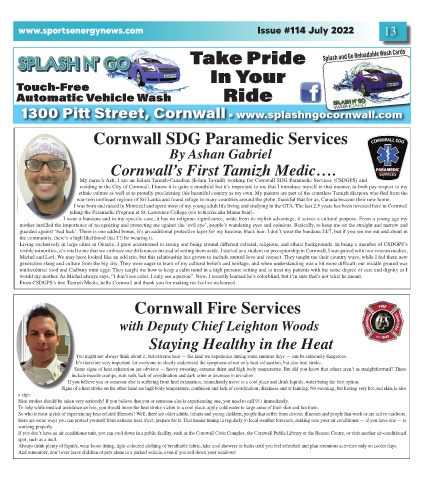
                                           Cornwall’s First Tamizh Medic….
                               My name’s Ash, I am an Eelam Tamizh-Canadian (E-lam Ta-mill) working for Cornwall SDG Paramedic Services (CSDGPS) and
                               residing in the City of Cornwall. I know it is quite a mouthful but it’s important to me that I introduce myself in that manner, to both pay respect to my
                               ethnic culture as well as to proudly proclaiming this beautiful country as my own. My parents are part of the countless Tamizh diaspora who fled from the
                              war-torn northeast regions of Sri Lanka and found refuge in many countries around the globe, thankful that for us, Canada became their new home.
                             I was born and raised in Montreal and spent most of my young adult life living and studying in the GTA. The last 2.5 years has been invested here in Cornwall
                           taking the Paramedic Program at St. Lawrence College (s/o to Karrie aka Mama bear).
                         I wear a bandana and in my specific case, it has no religious significance, aside from its stylish advantage, it serves a cultural purpose. From a young age my
        mother instilled the importance of recognizing and protecting me against the ‘evil eye’, people’s wandering eyes and opinions. Basically, to keep me on the straight and narrow and
        guarded against ‘bad luck’. There is one added bonus, it’s an additional protective layer for my luscious black hair. I don’t wear the bandana 24/7, but if you see me out and about in
        the community, there’s a high likelihood that I’ll be wearing it.
        Living exclusively in large cities in Ontario, I grew accustomed to seeing and being around different cultural, religious, and ethnic backgrounds. In being a member of CSDGPS’s
        visible minorities, it’s vital to me that we embrace our differences instead of setting them aside. I started as a student on preceptorship in Cornwall, I was paired with two veteran medics,
        Michel and Lori. We may have looked like an odd trio, but this relationship has grown to include mutual love and respect. They taught me their country ways, while I fed them new
        generation slang and culture from the big city. They were eager to learn of my cultural beliefs and heritage, and when understanding was a bit more difficult, our middle ground was
        multicultural food and Cadbury mini eggs. They taught me how to keep a calm mind in a high pressure setting and to treat my patients with the same degree of care and dignity as I
        would my mother. As Michel always says, “I don’t see color, I only see a person”. Now, I recently learned he’s colorblind, but I’m sure that’s not what he meant.
        From CSDGPS’s first Tamizh Medic, hello Cornwall and thank you for making me feel so welcomed.


                                                    Cornwall Fire Services


                                              with Deputy Chief Leighton Woods


                                                         Staying Healthy in the Heat


                              You might not always think about it, but extreme heat — the kind we experience during some summer days — can be extremely dangerous.
                              It’s therefore very important for everyone to clearly understand the symptoms of not only heat exhaustion, but also heat stroke.
                             Some signs of heat exhaustion are obvious — heavy sweating, extreme thirst and high body temperature. But did you know that others aren’t as straightforward? These
                            include muscle cramps, skin rash, lack of coordination and dark urine or decrease in urination.
                           If you believe you or someone else is suffering from heat exhaustion, immediately move to a cool place and drink liquids, water being the best option.
                        Signs of a heat stroke on the other hand are high body temperature, confusion and lack of coordination, dizziness and or fainting. No sweating, but having very hot, red skin, is also
        a sign.
        Heat strokes should be taken very seriously! If you believe that you or someone else is experiencing one, you need to call 911 immediately.
        To help while medical assistance arrives, you should move the heat stroke victim to a cool place, apply cold water to large areas of their skin and fan them.
        So who is most at risk of experiencing heat-related illnesses? Well, there are older adults, infants and young children, people that suffer from chronic illnesses and people that work or are active outdoors.
        Here are some ways you can protect yourself from extreme heat. First, prepare for it. That means tuning in regularly to local weather forecasts, making sure your air conditioner — if you have one — is
        working properly.
        If you don’t have an air conditioner unit, you can cool down in a public facility, such as the Cornwall Civic Complex, the Cornwall Public Library or the Benson Centre, or visit another air-conditioned
        spot, such as a mall.
        Always drink plenty of liquids, wear loose-fitting, light-coloured clothing of breathable fabric, take cool showers or baths until you feel refreshed and plan strenuous activities only on cooler days.
        And remember, don’t ever leave children or pets alone in a parked vehicle, even if you roll down your windows!

